
 en
 日本語
 한국어
 русский


Industry News
 Home / News / Industry News / Umbrella Spokes Explained: Rib Count, Materials and Wholesale Buying Guide
Umbrella Spokes Explained: Rib Count, Materials and Wholesale Buying Guide
 2026.11.14
 Industry News
Your sample arrives with six ribs. The catalog photo showed eight. The buyer now wants to know why the quotation dropped by a few cents and whether that difference will come back as complaints by December. That is usually the moment a conversation about umbrella spokes stops being a technical detail and becomes a commercial one.
The short answer before the detail: rib count and rib material decide most of what a buyer actually feels after delivery. They influence how the canopy behaves in a crosswind, how the umbrella sits in one hand, how many pieces come back as returns, and how much margin survives the season. Canopy artwork sells the first unit; the frame decides whether the buyer places a second order.
This guide comes from the production floor of an umbrella factory in Shangyu, the umbrella manufacturing cluster in Zhejiang, China, where straight umbrellas, folding umbrellas, beach umbrellas and garden umbrellas are built for retailers, distributors and brand programmes. It covers the vocabulary, how rib count and material change real performance, where frames fail, and how to write a purchase order that leaves less to luck.
A canopy is what the customer sees; the spokes are what the customer judges after the third windy day.
Content
- 1 What Umbrella Spokes Do and What They Are Called
- 2 How Umbrella Spoke Count Changes Strength, Weight and Cost
- 3 Umbrella Spoke Materials: Steel, Fibreglass, Aluminium and Carbon
- 4 Spoke Geometry: Straight, 3-Fold and 5-Fold Frames
- 5 Where Umbrella Spokes Fail First
- 6 A Wholesale Checklist for Umbrella Spokes and Ribs
- 7 Matching Umbrella Spokes to Beach, Patio, Kids and Reverse Lines
- 8 Repair, Spare Ribs and After-Sales Reality
- 9 Working With Our Factory on Umbrella Spoke Specifications
- 10 FAQ: Umbrella Spokes and Rib Specifications
- 10.1 How many umbrella spokes does a normal umbrella have?
- 10.2 Are umbrella spokes and umbrella ribs the same thing?
- 10.3 Are fibreglass or steel umbrella ribs stronger?
- 10.4 Can broken umbrella spokes be repaired?
- 10.5 Do more umbrella spokes always mean better wind resistance?
- 10.6 What is a double rib or 16-rib umbrella frame?
- 10.7 How does rib length relate to canopy size?
- 10.8 How can a buyer check rib quality before a bulk order?
- 10.9 Which rib count suits promotional umbrellas?
What Umbrella Spokes Do and What They Are Called
In the trade, umbrella spokes are normally called ribs. If a buyer asks for spokes and a factory quotes ribs, both sides mean the same part, but the word drifts between workshops: some use "spoke" loosely for the stretcher link as well, so confirm the name on a drawing rather than in a chat message. A specification sheet that labels every part removes most misunderstandings before sampling starts.
Functionally, a rib is a cantilever. It holds the canopy under tension, transfers wind load back to the shaft through the stretcher and runner, and sets the folded length of the whole product. Rib length also sets the open canopy arc, which is why a 21-inch rib and a 23-inch rib can look almost identical in a photograph but feel completely different in the hand.
The frame is a system, not a single part. A rib that springs back beautifully will still disappoint if the runner jams or the rivet at the hinge wears oval after 200 open-close cycles. The table below lists the parts that matter most when a buyer writes a purchase order, and what is worth confirming in writing.
| Part | What it does | What to confirm |
|---|---|---|
| Rib (spoke) | Holds the canopy tension and carries wind load | Count, material, diameter, length, finish |
| Stretcher | Links rib to runner and controls opening angle | Material and thickness, matched to the rib |
| Runner | Slides on the shaft to open and lock the frame | Locking feel, plastic grade, spring type |
| Top hub / notch | Anchors all ribs at the top of the shaft | Rivet or screw fixing, wall thickness |
| Rib tip (ferrule) | Fits into the canopy pocket and protects the seam | Tip shape, pull-out force, rounded edges for kids |
| Hinge and rivet | Allows folding on 3-fold and 5-fold frames | Rivet diameter, plating, hinge clearance |
| Shaft | Takes the bending load from rib to handle | Steel, aluminium or fibre, wall thickness |
| Canopy pocket | Stitches the canopy to the rib tip | Stitch density, reinforcement patch |
A useful habit for buyers: ask the supplier to send one opened frame without the canopy. Ten minutes with a bare frame tells you more about rivet play, rib straightness and coating quality than any finished sample photograph.
Umbrella spokes are structural, not cosmetic: they carry wind load, set folded length, and decide whether the canopy still looks taut after a season of use.
How Umbrella Spoke Count Changes Strength, Weight and Cost
Six, eight, ten, sixteen, twenty-four. Those numbers on a product page are not marketing decoration; each one describes a different loading pattern on the canopy. More ribs mean shorter unsupported spans of fabric between them, which reduces flapping and spreads wind pressure over more anchor points. Fewer ribs mean less weight, less material and a lower price, with a canopy that moves more in gusts.
The count also changes how round the open canopy looks. A six-rib pocket umbrella tends to read as slightly polygonal when viewed from above; an eight or ten rib frame reads as a clean circle. For retail display and product photography, that difference matters more than most spec sheets admit.
Where the extra cost actually sits
Every additional rib adds raw material, a stretcher, a hinge set, a rib tip, several metres of stitching and a few seconds of assembly labour. It also adds an inspection point, because a 24-rib frame has roughly three times the joint count of an 8-rib frame. On the other side of the ledger, a stronger frame usually reduces returns and replacement shipments, especially for coastal cities, exposed promenades and windy transit corridors.
One naming detail that trips up first-time buyers: a "16-rib" windproof frame is usually a double-rib structure with eight main ribs plus eight short ribs stitched into the canopy panels. The short ribs do not run to the hub; they stiffen the fabric between main ribs and help the canopy recover after inversion. When comparing quotations, confirm whether 16 means sixteen full ribs or eight main plus eight short, because the two are not interchangeable.
The chart below is an illustrative index built from our own sampling experience across product families. It is a comparison tool for internal buying discussions, not a certified laboratory result.
The index rises faster between 8 and 16 ribs than between 16 and 24, which is why the double-rib construction is the sweet spot for most windproof programmes. A 24-rib frame still earns its place for coastal retail, golf and heavy-duty stick umbrellas where weight is accepted in exchange for stiffness. A 6-rib frame remains the correct choice for pocket umbrellas, where folded size and grams matter more than gust performance.
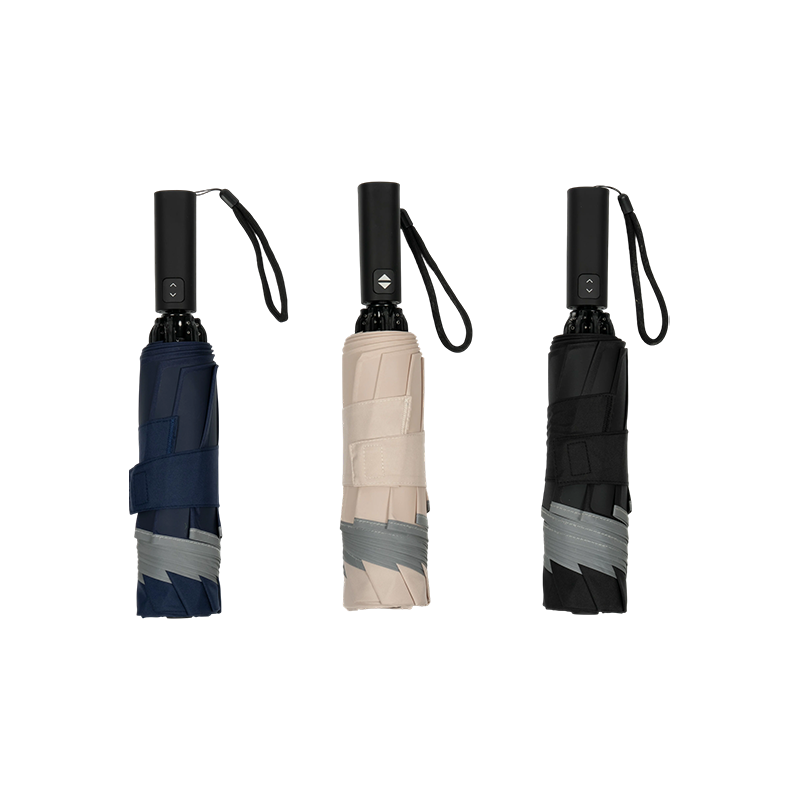
For buyers building a windproof line, the 16-rib automatic stick frame is a practical starting point because it balances canopy tension against a carry weight that still suits commuters. Our own 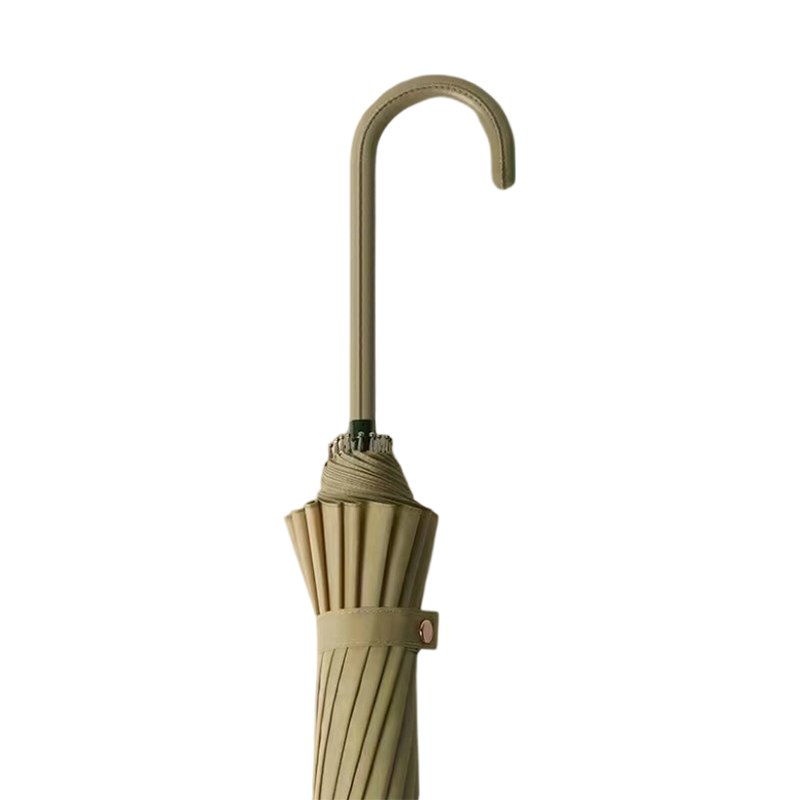 16-Rib Automatic Windproof Stick UmbrellaA reinforced 16-rib automatic stick umbrella balancing wind support and commuter carry weight, with customizable frame, canopy and handle options for wholesale programmes.View Product → programme was developed around exactly this trade-off: eight main ribs plus short stiffening ribs, an automatic opening mechanism and a shaft sized for the extra load.
One caveat worth repeating to any sourcing team: rib count alone does not guarantee wind performance. Canopy fit, venting, fabric weight, shaft stiffness and the quality of the runner all share the load. A loose 16-rib canopy will invert before a well-fitted 8-rib canopy every time.
Going from 8 to 16 ribs rarely doubles the unit price, but it often cuts wind-related complaints sharply on exposed accounts, so always request both quotations side by side.
Umbrella Spoke Materials: Steel, Fibreglass, Aluminium and Carbon
Material choice decides how a rib fails. Steel ribs hold their shape under load and then bend permanently once the yield point is passed. Fibreglass ribs flex further and spring back, which makes them forgiving in gusts, but they can splinter at a broken end. Aluminium sits between the two: light, corrosion-resistant, and prone to gentle bending rather than snapping. Carbon fibre ribs are the stiffest and lightest option per gram, with a price and a brittleness at the joint that not every price point can justify.
Finish matters as much as base material. A black-painted steel rib looks identical to a zinc-plated one on the sample table, but the two behave differently after four weeks in a humid container. Condensation inside a sealed carton is a real risk on long sea freight, and painted steel with a thin coat is usually the first part to show rust spots. Buyers shipping to coastal or tropical markets should specify the finish explicitly, not assume it.
| Material | Weight feel | Behaviour in gusts | Corrosion risk | Typical use |
|---|---|---|---|---|
| Painted steel | Heavier | Stiff, then bends permanently | Higher if coating is thin | Value stick and promotional umbrellas |
| Zinc-plated steel | Heavier | Stiff, good spring at low cost | Moderate | Mid-range folding and stick frames |
| Fibreglass | Light to medium | Flexes and recovers well | Low | Windproof, beach and garden frames |
| Aluminium | Light | Soft bend, less spring-back | Low | Patio umbrellas and lightweight folding frames |
| Carbon fibre | Lightest | Stiff and quick to recover | Very low | Premium compact and travel umbrellas |
Mixed frames are the norm rather than the exception. A common build pairs fibreglass ribs with an aluminium shaft and a steel stretcher, taking flexibility where the canopy bends and stiffness where the load concentrates. When a supplier quotes "fibreglass frame", ask which parts are actually fibreglass, because a fibreglass rib set on a steel shaft is still a different product from a full composite frame.
Heavy-duty programmes usually go the other way, accepting more steel in exchange for a frame that will not fold under a canopy of two or three kilograms. Our 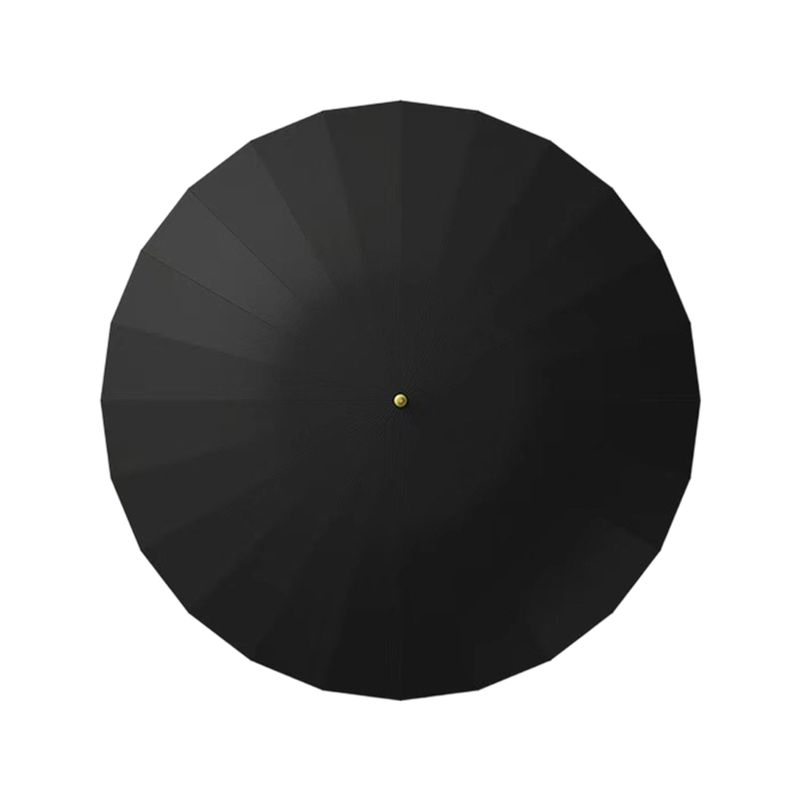 24-Rib Heavy-Duty Windproof Stick UmbrellaA reinforced 24-rib stick umbrella built for heavy rain and strong winds, with steel, fiberglass or hybrid frame and canopy customization for bulk orders.View Product → heavy-duty line follows that logic: high rib count, thicker shaft, and a material set chosen for loads rather than for pocket weight.
Match the finish to the climate before you argue about rib count: a thin painted steel rib can show rust within one humid season, while well-coated aluminium and fibreglass tolerate far more.
Spoke Geometry: Straight, 3-Fold and 5-Fold Frames
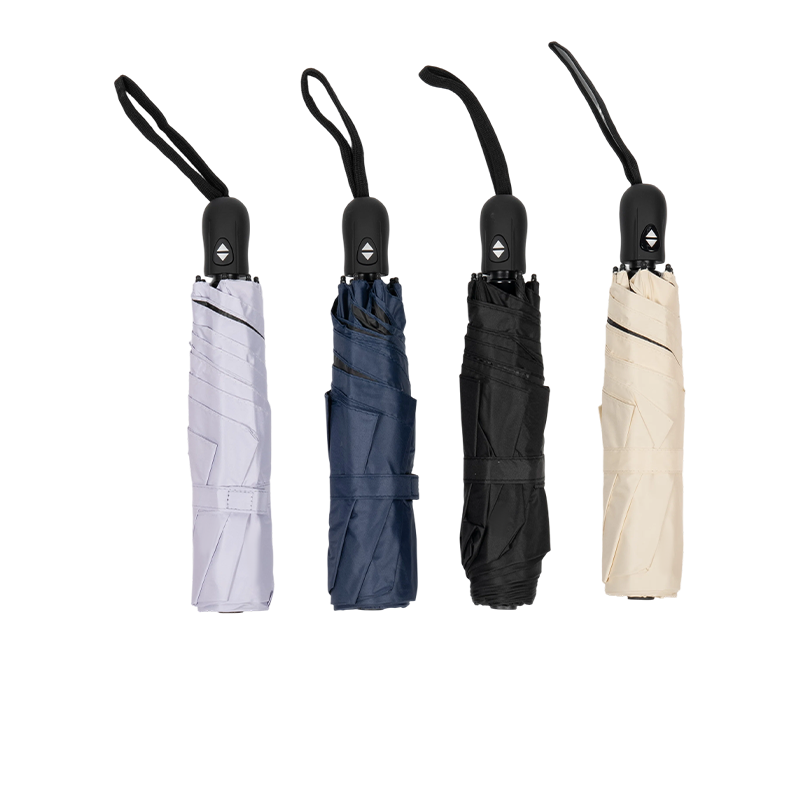
Rib geometry is where folded length is won or lost. A straight umbrella uses one full-length rib with a single hinge near the runner, so the open diameter is roughly twice the rib length and the folded length is roughly the rib length plus handle. A 3-fold umbrella breaks each rib into two or three sections, letting the frame fold to about a third of its open span. A 5-fold frame adds another joint or two, compressing the package further at the cost of thinner rib stock and more rivets to wear.
This is why the same 21-inch rib length can produce three very different products. In a straight stick frame it suggests a generous canopy; in a 3-fold it is a standard commuter size; in a 5-fold the ribs are sectioned so aggressively that the folded body is barely wider than a phone. Buyers who compare only the "21 inch" number across these formats are comparing folded length labels, not canopy performance.
Joint count has a direct maintenance cost. Every hinge is a wear point, and every rivet is a place where play develops. A 5-fold frame with four joints per rib needs tighter assembly tolerances and better rivet plating than a 3-fold frame with two, and it will not tolerate the same canopy weight. If a 5-fold umbrella is asked to carry a heavy pongee canopy with a thick coating, the frame is working outside its design envelope and the returns will show it.
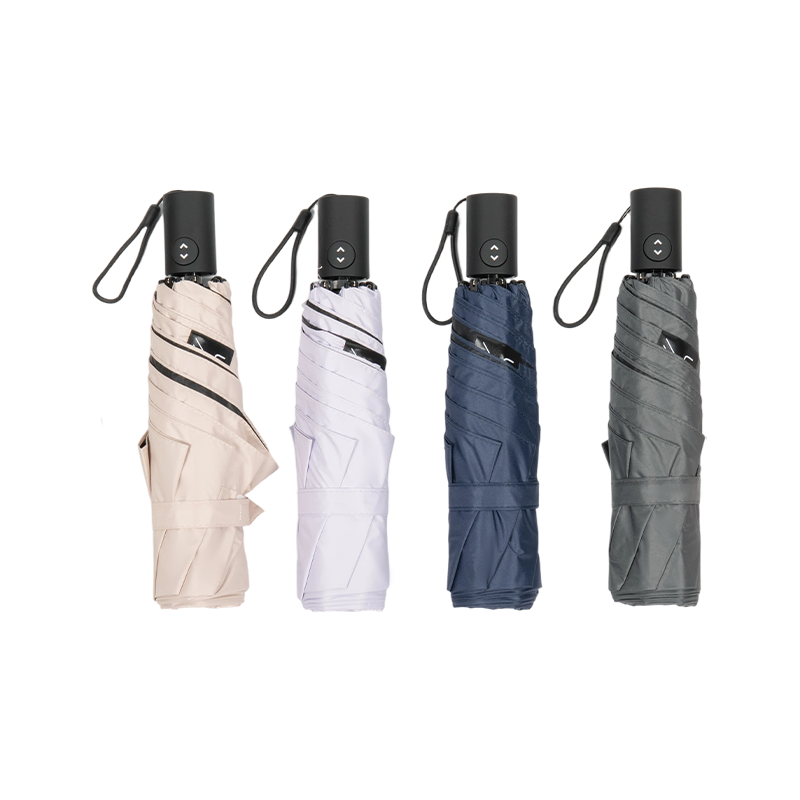
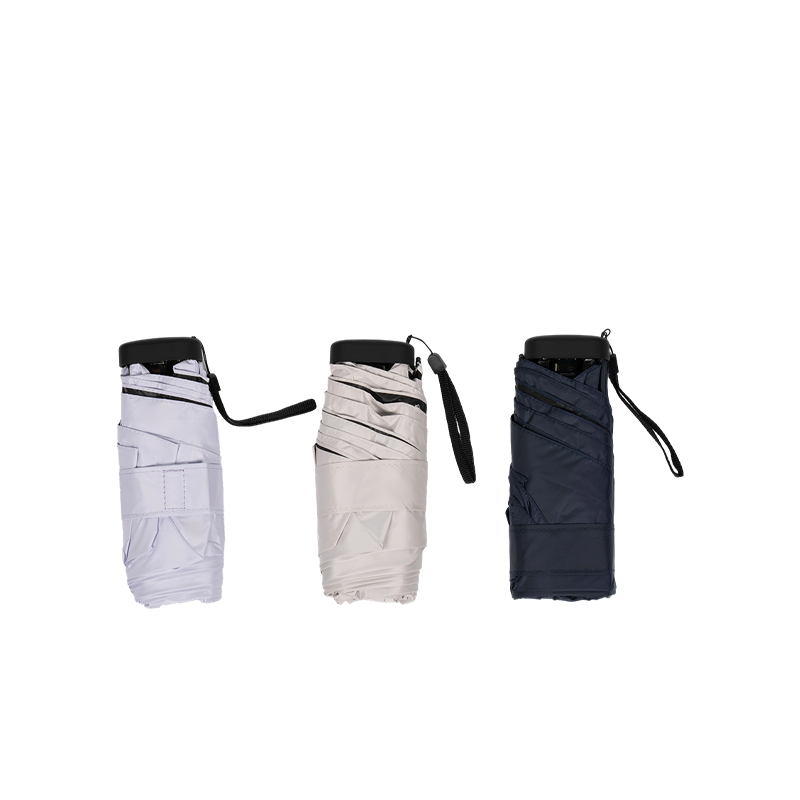
Lightweight frames reward careful material choice. A compact 5-fold built on carbon fibre ribs can stay under the weight threshold that makes a pocket umbrella feel like a brick, while a steel version of the same geometry tends to feel dense in the hand. Our 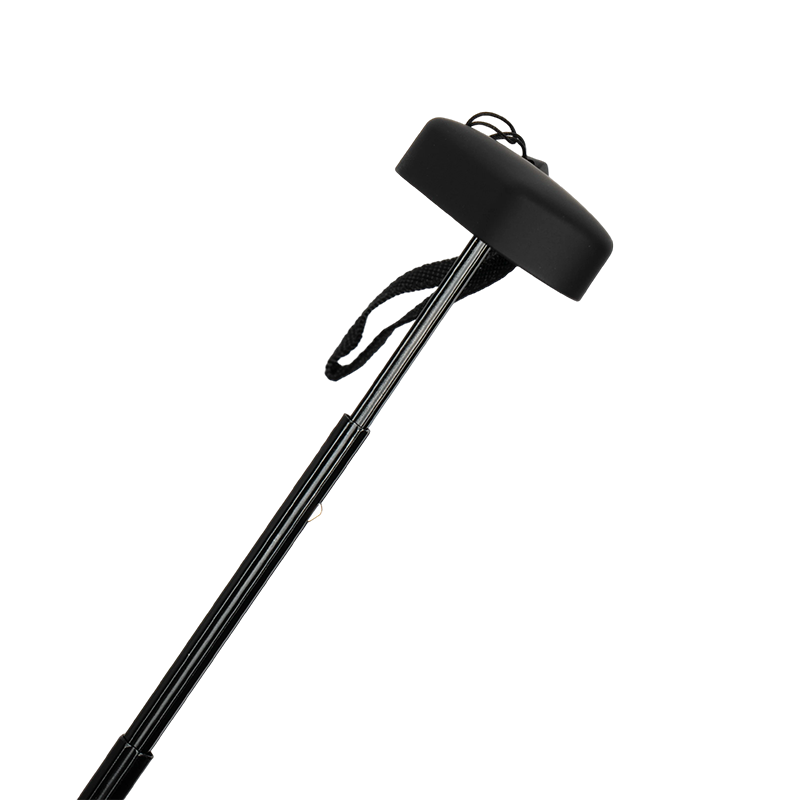 5-Fold 6-Rib Ultra-Light Carbon Fiber UmbrellaA compact 5-fold umbrella using carbon-fiber ribs and sun-blocking coated fabric, suited to daily carry and customizable for wholesale private-label ranges.View Product → flat 5-fold model is built around that trade-off, using a low rib count with high-stiffness material rather than adding ribs to a frame that cannot carry them.
For a deeper comparison of straight, 3-fold and 5-fold frame structures, our technical note on 8-rib stick umbrellas against 3-fold and 5-fold formats walks through hinge layout and folded-length maths with drawings.
Every extra fold removes length and adds a hinge, so a 5-fold frame should be specified with lighter canopy weight and tighter rivet tolerances than a 3-fold frame.
Where Umbrella Spokes Fail First
Most umbrellas do not break; they invert. A gust catches the canopy, the fabric lifts, the ribs flip over the top, and the frame either recovers or stays bent. Where the failure lands tells you what to inspect. In our experience the sequence of complaints runs roughly like this: canopy pocket tears around the rib tip, rib tip pulls out of the pocket, stretcher hinge develops play, runner jams on the shaft, and finally the top hub cracks after repeated stress.
Rib tips deserve more attention than they get. A tip that is too sharp cuts the pocket stitching from inside; a tip that is too loose slides out and leaves the canopy flapping on one panel. A pull-out force check on a finished sample takes seconds with a simple hook gauge and catches the weak assemblies before production. On children's umbrellas, rounded tips and covered hinges are not optional, they are the specification.
Rivets are the second weak point. A rivet that is slightly undersized for the hinge hole will develop lateral play within a few hundred cycles, and once a hinge wobbles, the rib no longer holds its angle and the canopy goes slack on one side. Plated rivets in a humid climate also corrode, which tightens the joint and makes the umbrella harder to open. Neither problem appears in a fresh-out-of-carton inspection, which is why cycle testing matters.
Tests worth asking for before a bulk order
- Inversion test: open the umbrella and push the canopy back over the frame, then check whether ribs return to position.
- Open-close cycle test: several hundred cycles on the runner and hinges, watching for play and stiffness.
- Rib tip pull test: measure the force needed to pull a tip out of the canopy pocket.
- Salt spray check on plated parts if the destination market is coastal or humid.
- Folded length and weight measurement against the tolerance agreed in the purchase order.
Ask which failure mode a frame is designed to survive: most retail complaints come from inversion and rib tip pull-out, not from snapped steel.
A Wholesale Checklist for Umbrella Spokes and Ribs
A rib specification written in one paragraph is worth more than ten chat messages. The list below is the format we ask buyers to fill in before sampling, because it eliminates the most common source of dispute: two parties picturing different frames while agreeing on the same product name.
- Rib count, stated as main ribs and short stiffening ribs separately.
- Rib material and surface finish, including coating or plating type.
- Rib diameter or profile, with a tolerance in millimetres.
- Rib length in inches or centimetres, and the resulting open canopy diameter.
- Number of hinges per rib and rivet diameter and plating.
- Stretcher material and thickness, matched to the rib gauge.
- Rib tip style, material and pull-out force target.
- Top hub construction, riveted or screwed, with wall thickness.
- Folded length and product weight, each with an agreed tolerance, commonly plus or minus one centimetre and around five percent on weight.
- Colour tolerance for coated frames, typically within a small Delta E window against the approved standard.
- Test reports required, and whether they are per order or per model year.
- Spare rib and spare tip allowance packed with the shipment, expressed as a percentage of order quantity.
Two practical notes on tolerances. First, agree the measurement method as well as the number, because folded length measured with the strap included differs from folded length measured on the body. Second, keep the tolerance realistic: a hand-assembled 24-rib frame will not hit a one-millimetre folded length window consistently, and demanding it only pushes cost up without improving the product.
Write the rib specification as a numbered list with tolerances before sampling; it costs twenty minutes and prevents most bulk-order disputes.
Matching Umbrella Spokes to Beach, Patio, Kids and Reverse Lines
Different product families load their spokes in different ways, so a single frame recipe rarely covers a whole catalogue. A beach umbrella fights steady onshore wind for hours; a garden umbrella carries a canopy several metres wide on a pole; a child's umbrella gets dragged along the pavement; a reverse folding umbrella relies on rib geometry that most standard frames cannot deliver.
| Product family | Typical rib count | Common rib material | Specification to watch |
|---|---|---|---|
| Pocket and mini folding | 6 | Aluminium or carbon fibre | Folded length and weight |
| Standard 3-fold commuter | 8 | Steel or fibreglass | Hinge play after cycles |
| Windproof stick | 16 (8 main plus 8 short) | Fibreglass with steel shaft | Inversion recovery and venting |
| Heavy-duty stick | 24 | Steel or thick fibreglass | Shaft stiffness and hub strength |
| Reverse folding | 8 | Fibreglass | Pre-bent rib geometry and double canopy |
| Beach umbrella | 8 | Fibreglass | Rib thickness and pole joint |
| Garden and patio | 6 to 8 | Aluminium | Rib length against canopy diameter and crank load |
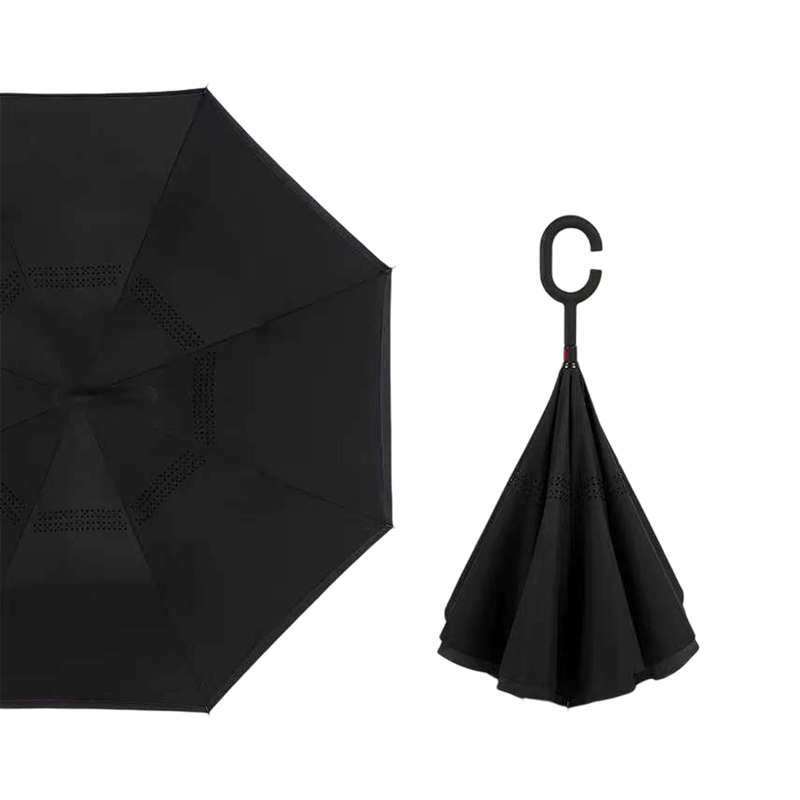
Reverse folding umbrellas are a special case worth flagging. The frame has to be assembled so the canopy folds inward, which means the rib set is pre-formed rather than straight, and the canopy uses two layers. A supplier who has not built reverse frames before will often quote a standard frame with a reversed canopy, and the result jams on the second open. Ask for a video of the actual open-close action, not a still photo.
Beach and garden frames carry a different burden: steady load rather than sudden gusts. Rib thickness and pole strength matter more than hinge count, and the wind vent at the canopy top does real work by letting pressure escape. For a beach line, a fibreglass rib set at eight count with a properly reinforced tip pocket usually outperforms a heavier steel set that rusts after a season near salt water.
Specify the frame per product family, not per catalogue: pocket, windproof, reverse, beach and patio umbrellas each load their spokes differently.
Repair, Spare Ribs and After-Sales Reality
Some consumers do repair their umbrellas. Broken rib tips, a slipped stretcher and a loose rivet are all fixable with basic tools, and repair culture is strong in markets where a good umbrella is treated as an object rather than a consumable. But repair only works when the frame is designed for it. Rivets that can be replaced, tips that can be pushed back into the pocket, and a hub that is screwed rather than sealed all make the difference between a five-minute fix and a landfill item.
For wholesale buyers, the practical answer is a spare parts allowance. Shipping a small percentage of spare rib sets and tips with each container costs very little and gives retail partners something concrete to offer. It also reduces the number of whole-unit replacements for a single failed tip, which is where after-sales cost usually hides.
Design decisions also affect repairability. A rib tip that is glued or heat-sealed into the pocket cannot be replaced without cutting stitches; a tip pushed into a reinforced pocket can. Screw-fixed hubs cost slightly more than riveted ones but allow a retailer to tighten a wobbling frame instead of writing it off. None of these choices are expensive at the sampling stage, and all of them are close to impossible to change once the canopy is in production.
Design the frame so a rib tip or rivet can be replaced in minutes; the spare parts allowance costs far less than whole-unit replacements.
Working With Our Factory on Umbrella Spoke Specifications
Shaoxing Shangyu Qianyu Umbrella Co., Ltd. is based in Songxia, Shangyu District, Shaoxing, Zhejiang, an area that has built umbrellas for decades. The company was founded in 2013, started as an e-commerce business focused on light-style ladies' umbrellas, and now operates development, online and offline retail, and wholesale distribution together. The production base covers roughly 9,000 square metres with more than 120 staff, and the product range runs from 8-rib straight umbrellas, automatic stick umbrellas and heavy-duty 24-rib models through 3-fold and 5-fold folding frames to beach umbrellas, garden umbrellas and gazebo-style canopies.
Because the factory builds the whole spread rather than a single category, rib specifications can be matched to the product family instead of forced onto one frame. A buyer sourcing a windproof commuter line, a promotional 8-rib stick umbrella and a beach programme in one shipment can keep the canopy supplier, the rib gauge and the packing standard consistent across all three. For distributors and retail chains, that reduces the number of suppliers to audit and the number of specification sheets to maintain.
Working as an umbrella manufacturer rather than a trading desk also means frame changes can be discussed at the sample stage, when a rib gauge or hinge change still costs almost nothing. Buyers who need private label programmes, mixed container loads or repeat production across seasons usually find the conversation easier when the person quoting the price is also the person who can walk to the assembly line.
Next step for buyers
- Send your rib specification, target canopy size and destination market to our team and ask for a matched frame proposal with samples.
- Contact the sales team to start a sample request or a specification review.
Buy frames from the factory that assembles them: a rib gauge change discussed at sampling costs almost nothing, while the same change after production starts costs a season.
FAQ: Umbrella Spokes and Rib Specifications
How many umbrella spokes does a normal umbrella have?
Eight is the most common count for a standard folding or stick umbrella, because it gives a round canopy with reasonable strength at a moderate cost. Pocket umbrellas often use six to save weight and folded size, ten ribs appear on models where a rounder canopy matters, sixteen usually describes a double-rib windproof frame with eight main ribs plus eight short stiffening ribs, and twenty-four is a heavy-duty count for large or high-load frames.
Are umbrella spokes and umbrella ribs the same thing?
Yes. Rib is the standard trade term and spoke is the everyday word, and both describe the struts that hold the canopy. Because some workshops use spoke loosely for the stretcher link too, it is worth confirming part names on a drawing when you place a specification.
Are fibreglass or steel umbrella ribs stronger?
They fail differently rather than simply ranking one above the other. Steel ribs are stiffer and resist bending under load but stay bent once deformed, while fibreglass ribs flex further and recover. For gusty, exposed conditions fibreglass is often the more forgiving choice, and for heavy canopies on large frames a steel or reinforced structure usually carries the load better.
Can broken umbrella spokes be repaired?
Sometimes. A pulled rib tip, a loose rivet or a slipped stretcher can usually be fixed with basic tools, especially if the frame uses replaceable rivets and push-in tips. A cracked top hub or a rib broken mid-section is harder to repair economically, which is why repairability should be designed in at sampling rather than discussed after the first returns arrive.
Do more umbrella spokes always mean better wind resistance?
No. Rib count helps by shortening the unsupported span of fabric, but canopy fit, venting, fabric weight, shaft stiffness and runner quality all share the load. A well-fitted eight-rib frame can outperform a loose sixteen-rib frame, so wind performance should be tested on the finished product rather than inferred from the number on the label.
What is a double rib or 16-rib umbrella frame?
It is a frame with eight full-length main ribs plus eight short ribs stitched into the canopy panels between them. The short ribs do not reach the hub; they stiffen the fabric, reduce flapping and help the canopy recover after inversion. Always confirm whether a quoted sixteen refers to full ribs or to main plus short ribs, because the structures are different.
How does rib length relate to canopy size?
As a rule of thumb, the open canopy diameter is roughly twice the rib length, adjusted for the canopy curvature and the type of frame. A 21-inch rib therefore suggests a canopy around 96 to 100 centimetres across once fabric tension is taken into account, while a 23-inch rib gives a noticeably larger span. Confirm the actual open diameter rather than relying on the inch label alone.
How can a buyer check rib quality before a bulk order?
Request an opened frame without the canopy, then check rib straightness, coating coverage, rivet play and hinge clearance. Follow with an inversion test, a few hundred open-close cycles and a rib tip pull check on finished samples, and measure folded length and weight against the agreed tolerances. These checks take under an hour and catch most of the problems that would otherwise appear in customer reviews.
Which rib count suits promotional umbrellas?
Eight ribs remains the practical standard for promotional work: it produces a clean round canopy, keeps the unit cost predictable and offers enough frame strength for a printed giveaway. Six-rib mini frames make sense when the item must fit a small package, and sixteen-rib frames are better reserved for programmes where wind performance is the selling point.
Rib count is a starting point, not a guarantee: test the finished umbrella for inversion recovery, hinge play and tip retention before committing to volume.
Umbrella spokes are one of those components that only attract attention when something goes wrong, which is exactly why they deserve attention at the sampling stage. The buyers who avoid returns are rarely the ones who found the cheapest frame; they are the ones who wrote down the rib count, the material, the finish, the hinge specification and the tolerances, then tested a finished sample against that list before the container left.
If there is one habit worth carrying into the next order, it is this: ask for the bare frame as well as the finished umbrella. Ten minutes with an opened frame, a hook gauge and a cycle count tells you more about the product than any catalogue page, and it turns a vague conversation about quality into a specification both sides can verify.
Specify the frame in numbers, verify it on a bare sample, and the canopy will take care of itself.

Contact Us
-
Add:
On the east side of Baisong Road in Songyuan District, Shaoxing City, Zhejiang Province -
Phone:
+86-18457587893 -
Email:
grace@qyumbrella.com
Send Inquiry
To Contact Us
Copyright © Shaoxing Shangyu Qianyu Umbrella Co., Ltd. All Rights Reserved.
