
 en
 日本語
 한국어
 русский


Industry News
 Home / News / Industry News / How to Use a Beach Umbrella: Anchoring in Sand, Tilt Angles and Buyer Tips
How to Use a Beach Umbrella: Anchoring in Sand, Tilt Angles and Buyer Tips
 2026.11.23
 Industry News
The umbrella goes over before the cooler is open. A gust lifts the canopy, the pole pops out of the sand at a twenty-degree lean, and by the time someone reaches it the ribs are bent and the fabric is full of grit. Ten minutes earlier the same umbrella looked perfectly stable, because it had been pushed about twenty centimetres into dry sand and left standing straight up like a fence post.
That sequence is the whole lesson. Learning how to use a beach umbrella properly has very little to do with which model you bought and almost everything to do with where you plant it, how deep the pole goes, which way it leans and when you decide to take it down. A modest umbrella set up well usually survives an afternoon that destroys an expensive one set up badly.
This guide covers the practical sequence we recommend to beach-goers, rental operators, event organisers and retail buyers: choosing the spot, anchoring depth, tilt angle, sand conditions, wind decisions, care and storage, and the details that matter when you are buying beach umbrellas by the container rather than by the piece.
If you want the short version first: bury around 30 to 45 cm of pole in damp compacted sand, tilt the canopy into the prevailing wind rather than straight up, and treat a gusty afternoon as a reason to lower the canopy instead of pushing the pole deeper.
Most beach umbrella failures are decided in the first ninety seconds: a shallow hole, a vertical pole and a canopy broadside to the wind will fail no matter how well the umbrella is built.
Content
- 1 How to Use a Beach Umbrella: Five Steps That Prevent Most Failures
- 2 Pick the Spot Before You Touch the Pole
- 3 Anchor Depth and Pole Angle: The Case for 30 to 45 Centimetres
- 4 Anchoring Methods Compared by Sand Condition
- 5 How Much Holding Power Each Anchoring Method Buys
- 6 Tilt Into the Wind, Then Rotate With the Sun
- 7 Sand Type Changes Everything
- 8 When the Wind Picks Up: The Take-Down Decision
- 9 Using a Beach Umbrella Off the Beach
- 10 What Retailers and Wholesalers Should Check Before Ordering
- 11 Care, Storage and the Salt Problem
- 12 Safety, Etiquette and Leaving the Beach as You Found It
- 13 FAQ: How to Use a Beach Umbrella, Anchor It and Buy It Well
- 13.1 How deep should a beach umbrella pole go into the sand?
- 13.2 Should a beach umbrella lean with the wind or against it?
- 13.3 Why does my beach umbrella keep falling over in soft sand?
- 13.4 Is a vented beach umbrella better in wind?
- 13.5 How many ribs should a beach umbrella have?
- 13.6 Can one person set up a beach umbrella alone?
- 13.7 What is the difference between a beach umbrella and a patio umbrella?
- 13.8 How do buyers evaluate a beach umbrella manufacturer or supplier?
- 14 Where to Go Next
How to Use a Beach Umbrella: Five Steps That Prevent Most Failures
Anyone who has watched a rental attendant set up twenty umbrellas in ten minutes knows the process is not complicated. It is ordered. Each step removes one of the reasons an umbrella goes over, and doing them in the right sequence is faster than correcting a bad setup later.
- Read the wind before you unzip anything. Stand still for thirty seconds and watch which way the canopy of a neighbour's umbrella leans, which way the sand is drifting and where the wave line sits. Wind direction decides the tilt, and the wave line decides whether your spot will be underwater in two hours.
- Clear and test the sand. Scrape away shells, glass and dry loose surface sand to reach the compacted layer below. Push your heel in. If your heel sinks easily, the pole will too, and you need a different anchoring approach rather than more force.
- Plant the pole 30 to 45 cm down, then compact. Push, twist and rock the pole back and forth while sand flows back around it. The rocking is not for show; it works sand into the cavity so the pole is gripped along its full buried length instead of sitting loose in a hole.
- Set the tilt, then lock it. Tilt the canopy into the wind so gusts press the fabric down instead of lifting it, then tighten the tilt joint. A joint left loose will drift all afternoon and slowly widen the hole at the base.
- Add a second line of defence and check it once an hour. A sand bag on the base, a guy line to a bag or a screw anchor turns a marginal setup into a reliable one. Then keep an eye on it: the tide, the wind and the number of people bumping the pole all change during the day.
The order matters because each step feeds the next. If you set the tilt before compacting the sand, tightening the joint rotates the pole and loosens the base. If you anchor before checking the tide, you may have to pull everything out at the worst moment. If you bury deep in dry sand, the hole walls crumble and the depth buys you nothing.
One more point that rarely gets mentioned: do not set up alone on a busy beach without agreeing on a boundary with your neighbours. Two umbrellas a metre apart will touch canopies at the first gust, and the one with the looser pole takes the blame.
Anchor deep, compact while you rock, tilt into the wind and then lock the joint, because a loose joint quietly undoes a good anchor.
Pick the Spot Before You Touch the Pole
Location is the cheapest form of wind protection you will ever get. A spot tucked behind a dune, a seawall or a row of vegetation sees noticeably less wind than open sand, and a spot above the high-tide line means you are not moving a fully loaded setup at the worst possible moment.
- Distance from the water: give yourself enough room that a normal high tide will not reach the base. If you are unsure, ask a lifeguard or check a local tide table rather than guessing from the wet sand line.
- Distance from other groups: two to three metres between poles keeps canopies from overlapping and gives everyone room to walk past without ducking.
- Sun path: morning shade and afternoon shade are in different places. If you plan to stay all day, choose a spot where you can rotate or re-tilt rather than one that only works at noon.
- Overhead: look up before you push. Power lines, low branches and coconut palms are all avoidable hazards.
- Access routes: never block a lifeguard lane, a ramp, a fire access point or the path between the car park and the water.
- Dunes and vegetation: in many coastal areas dunes are protected and digging into them is prohibited. Keep the pole on open sand.
A good spot also reduces the load on the umbrella. When the wind is funnelled over a dune, a canopy that would flap hard on open beach will sit comparatively calm. That difference in load is what separates a canopy that lasts three seasons from one that lasts one, because every flap works the ribs, the hub and the fabric seams a little further.
For families, there is a practical detail worth planning: the umbrella does not need to be where the towels are. Put the pole slightly upwind of your seating area so the shade falls on the group, and keep the walkway side clear. If you are setting up for a group of ten or more, a cabana or gazebo-style canopy usually distributes shade better than three separate poles competing for the same patch of sand.
Choosing a sheltered spot above the tide line costs nothing and removes more wind load than any accessory you can buy.
Anchor Depth and Pole Angle: The Case for 30 to 45 Centimetres
Beach safety guidance commonly describes pushing the pole down and then rocking the whole umbrella back and forth until roughly 45 cm, or about 18 inches, of the pole is buried. That figure is a useful starting point rather than a law of physics. Loose dry sand needs more depth; damp compacted sand holds well at the lower end; pebbles and shell beds may hold at almost any depth but will not let the pole bite at all.
The technique matters as much as the depth. Pushing straight down compresses sand into a plug at the bottom of the hole and leaves the sides loose. Twisting the pole as you push cuts a cleaner shaft, and rocking it from side to side lets sand fall back in around the pole and pack tightly. Stop rocking when the pole feels firm and the sand around the base stops moving.
What a good anchor actually feels like
Grip the pole at knee height and push sideways with moderate force. There should be a small amount of flex in the pole, but the base should not shift. If the whole pole pivots like a lever, the buried section is too short or the surrounding sand is too loose. If the pole feels rigid but the sand around the base cracks, the hole is too wide and needs repacking in layers.
Pole diameter also plays a role. A 28 mm pole in soft sand needs more depth than a 32 mm pole because it has less surface contact with the sand. Thin poles with a small ground spike can feel reassuring during setup and then work loose as the canopy moves, so a wider spike or a separate sand anchor is usually worth the small extra weight in the carry bag.
Angle is the other half of the anchor. A pole buried vertically and left vertical presents the full canopy to the wind. Tilting the pole 10 to 20 degrees into the wind changes the load direction, pressing the canopy down instead of lifting it, and puts part of the force into the side wall of the hole rather than the base. The cost is that the canopy sits lower on one side, so tall users should tilt along the axis that keeps headroom where people actually sit.
Depth without compaction is just a deeper hole: rock the pole while it is buried so sand grips the full length of the shaft.
Anchoring Methods Compared by Sand Condition
There is no single best anchor, only the best anchor for the sand in front of you. The table below maps common beach conditions to the setup that usually works, along with the extra step that most often makes the difference between a stable umbrella and a leaning one.
| Sand condition | What usually happens | Better anchoring approach | Extra step worth taking |
|---|---|---|---|
| Dry, loose, wind-blown sand | Hole walls collapse and holding depth drops quickly | Screw-in sand anchor or a long auger-style pole | Repack sand in shallow layers while rocking the pole |
| Damp, compacted sand near the waterline | Good grip, but tide risk is high | Direct burying to 30 to 45 cm | Note the tide time and move the setup if needed |
| Shell, pebble or coral rubble | Pole will not bite and wobbles on stones | Weighted base with a short buried section | Clear a 30 cm circle of stones before digging |
| Fine sand with a hard surface crust | Crust gives false confidence during setup | Tilted pole plus guy line or sand bags | Press the base with body weight before opening the canopy |
| Wet sand within reach of the waves | Excellent early grip, then sudden collapse | Move back and bury normally | Treat the wet strip as temporary, not as a base |
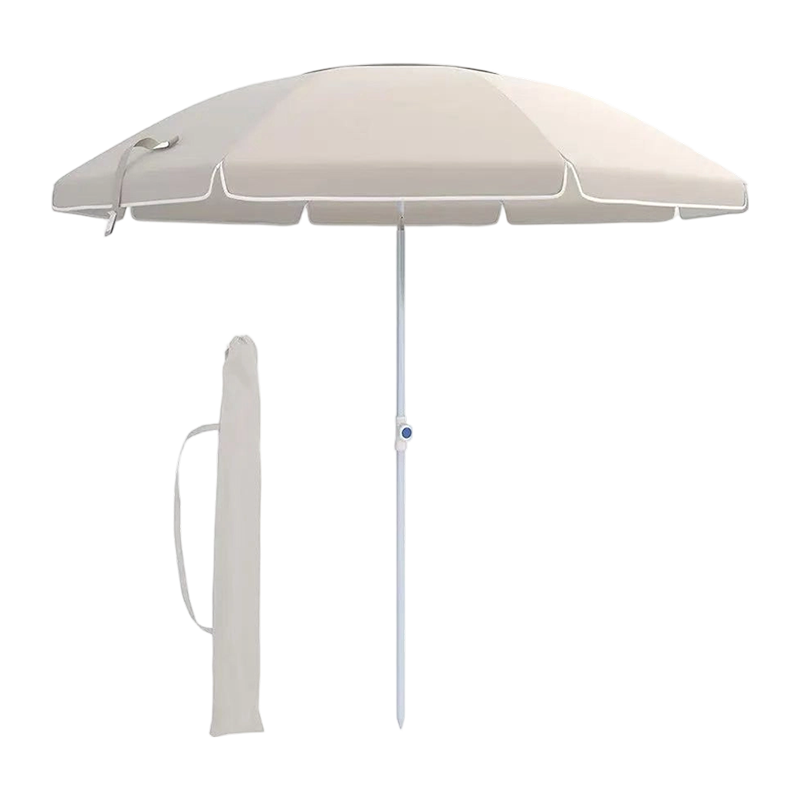
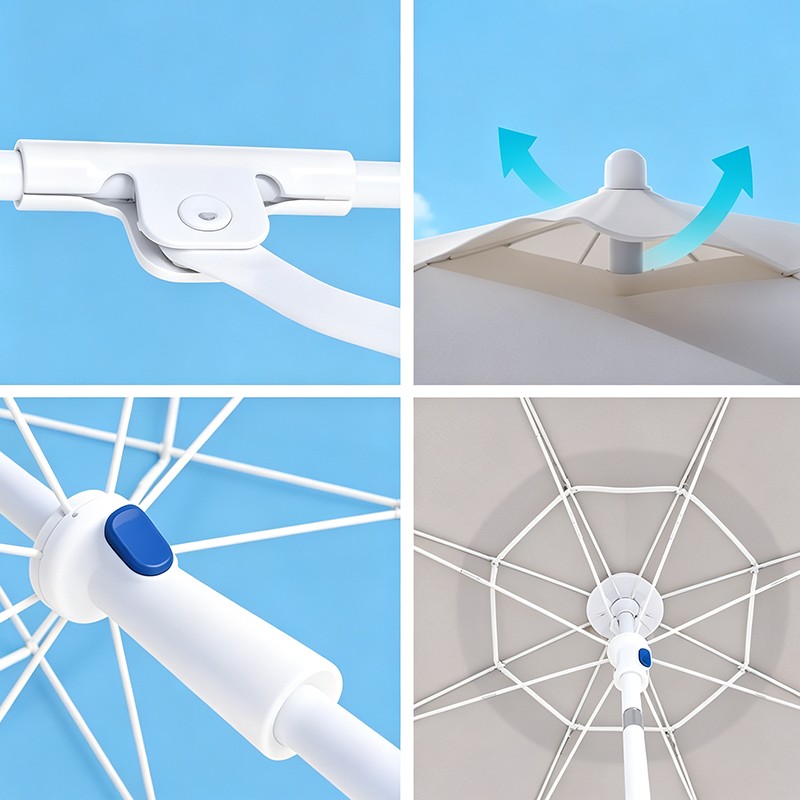 Fiberglass-Rib Beach Umbrella with TiltIts 5mm fiberglass ribs flex under load, while the vented 160G canopy and tilt mechanism support stable shade in windy beach setups.View Product →
Fiberglass ribs deserve a mention here because anchoring and wind load are connected. A pole that shifts slightly under load transfers movement into the ribs; fiberglass flexes and returns, while a stiff steel rib may bend and stay bent. That is one reason beach umbrellas aimed at windy coastlines often use fiberglass rather than steel for the rib structure.
Match the anchor to the sand, not to the umbrella: loose dry sand and shell beds need a different approach from damp compacted beach.
How Much Holding Power Each Anchoring Method Buys
The difference between anchoring methods is easier to see than to describe, so the chart below ranks common setups by relative holding score in medium-dry sand. It is an illustrative comparison based on typical field behaviour, not a laboratory measurement, and it is meant to show the gap between setups rather than an exact number.
Screw-in sand anchor with compacted sand
Relative score 82
Pole buried 30 to 45 cm and repacked
Relative score 70
Sand bags on a cross base, short burial
Relative score 58
Vertical pole, shallow hole, no weight
Relative score 22
The chart makes an obvious point that is easy to forget on a hot afternoon: the two strongest setups both involve compaction or a mechanical anchor, while the weakest setup is the one most people use by default. Adding weight to a shallow hole helps, but it does not close the gap with a properly buried pole.
For buyers, the practical takeaway is that anchoring accessories are not upsells, they are part of the product experience. A beach umbrella sold with a screw anchor, a sand bag or a wider ground spike tends to earn better reviews than an identical canopy sold with a thin spike, because customers judge the umbrella by whether it stayed up. Retail programmes that bundle an anchor with the canopy often see fewer returns for the same reason.
The scores also explain why rental operators prefer auger poles and heavy bases. Their umbrellas are handled by people who did not set them up and will not maintain them, so the anchor has to tolerate rough use. A rental-grade setup should hold with less skill, which usually means more metal in the ground and less reliance on technique.
The biggest single improvement most beach-goers can make is moving from a shallow vertical pole to a compacted 30 to 45 cm burial with a secondary anchor.
Tilt Into the Wind, Then Rotate With the Sun
A beach umbrella is not a parasol on a stand. It has to work with two forces at once, wind and sun, and those forces rarely come from the same direction all day. The practical routine is to set the tilt into the wind in the morning, then rotate the canopy as the sun moves so the shade stays where people actually sit.
Tilting into the wind works because the canopy presents a lower angle to the airflow. Instead of air getting under the edge and lifting, it slides over the fabric and presses the umbrella down. The same tilt that makes the umbrella more stable also shifts the shade sideways, which is why the direction of the tilt should be decided at the same time as the seating layout.
- Tilt 10 to 20 degrees for most coastal conditions. More than that and the canopy loses headroom on one side and starts to look unstable.
- Loosen, adjust, retighten. Forcing a locked tilt joint is the fastest way to strip the mechanism or crack the connector.
- Rotate rather than re-dig. Many beach umbrellas allow the canopy to be turned on the pole, which is far easier than pulling the anchor out.
- Lower the canopy when the wind rises. A lower canopy has a shorter lever arm and less exposure.
On a very still day, tilt matters less and shade coverage matters more. Tilt toward the sun and accept that the setup is doing less wind work. On a gusty day, the priority reverses: tilt into the wind, even if the shade lands slightly off-centre, and let people move their chairs rather than fighting the canopy.
It is worth checking the tilt joint once an hour. A joint that drifts a few degrees at a time can end up with the canopy broadside to the wind without anyone noticing, and that is usually the moment a gust arrives. Wiping sand out of the joint at the end of the day also keeps the mechanism working season after season.
A canopy tilted into the wind sheds gust load, while a canopy left broadside converts the same gust into a lifting force at the base.
Sand Type Changes Everything
Two beaches a kilometre apart can behave completely differently under the same umbrella. Coarse sand with a mix of shell fragments drains well and grips firmly once compacted. Fine, uniform sand is smooth and pleasant to sit on and poor at holding a pole. The difference is not cosmetic; it decides how deep you need to go and whether an anchor is optional or essential.
You can read the sand in about ten seconds. Push your heel down hard. If it sinks several centimetres with little resistance, the surface layer is loose and you should dig past it. If it stops firmly, the compacted layer is close and a 30 cm burial will probably hold. If the heel crunches or slides sideways, you are on shell or pebble and a buried pole will not bite.
Dry sand versus damp sand
Damp sand near the waterline holds better because water creates surface tension between grains, but it comes with an obvious risk. The best-holding sand is often the sand the tide will reach first. Use that strip as a temporary base at your own risk, and if you do set up there, keep the umbrella light and be ready to move it.
Dry sand further up the beach is safer from the tide but looser. The answer is not brute force; it is a wider anchor, a screw base or a guy line attached to a sand bag. In very soft sand, a cross base buried flat with sand piled over it often holds better than a longer pole, because the load is spread over a larger area instead of concentrated at the tip.
One detail that catches people out is the crust. After a windy night, the surface of dry sand can form a thin hard crust that feels solid underfoot and then collapses as soon as the pole breaks through. Always test with real weight before the canopy goes up, not with a light push.
Test the sand with your heel before you test it with your umbrella, because the surface crust tells you almost nothing about what is underneath.
When the Wind Picks Up: The Take-Down Decision
Every beach has a moment in the afternoon when the wind crosses from pleasant to awkward. The signs are consistent: the canopy starts to ripple rather than breathe, the pole begins to hum, sand starts drifting at ankle height, and neighbouring umbrellas begin to lean in the same direction. That is the point to act, not the point to add another bag.
The correct response is usually to lower the canopy, not to push the pole deeper. Lowering reduces the lever arm and the sail area at the same time, and it takes seconds. If the wind continues to build, close the canopy completely, lay the pole flat and weigh it down with bags or a cooler. An umbrella lying on the sand cannot be lifted by a gust.
- Use the vents. A vented canopy lets air pass through the top instead of collecting under it, which reduces lift noticeably in gusty conditions.
- Add a guy line early. One line to a bag or a buried anchor point is easier to set up in calm weather than in rising wind.
- Never leave it unattended. An empty umbrella on a windy beach is a rolling hazard for other people, and most beach regulations treat it that way.
- Check local rules. Some beaches restrict umbrellas above a certain canopy size, require guy lines to be marked, or ban them entirely during high-wind warnings.
Rental operators have a harder version of this problem because the guest who rented the umbrella may not be present when the wind turns. The workable approach is a scheduled check, a policy that umbrellas are closed when gusts reach a set level, and a canopy design that tolerates being folded and reopened several times a day without the ribs losing their shape.
It is also worth remembering that wind on the beach is rarely steady. The dangerous moments tend to be short bursts rather than a continuous gale, which is exactly why a canopy that has been left up all afternoon can look fine for twenty minutes and then fail in five seconds.
Lowering the canopy early is the cheapest safety measure on the beach, and it protects the ribs as well as the people around you.
Using a Beach Umbrella Off the Beach
Plenty of beach umbrellas never see the sea. They end up on patios, at garden tables, over market stalls, beside food trucks, at campsites and at outdoor weddings. The setup logic changes in one important way: on a hard surface there is nothing to bury, so the base and the weighting become the entire anchor.
A base designed for paving needs to be heavy or fillable, and it needs to sit flat rather than on a slope or a loose joint between slabs. Sand bags hanging from the hub are a common solution for temporary setups because they can be emptied and refilled on site, which keeps transport weight down for event crews. For anything left out overnight, a weighted plate plus a tie to a fixed point is a safer combination than weight alone.
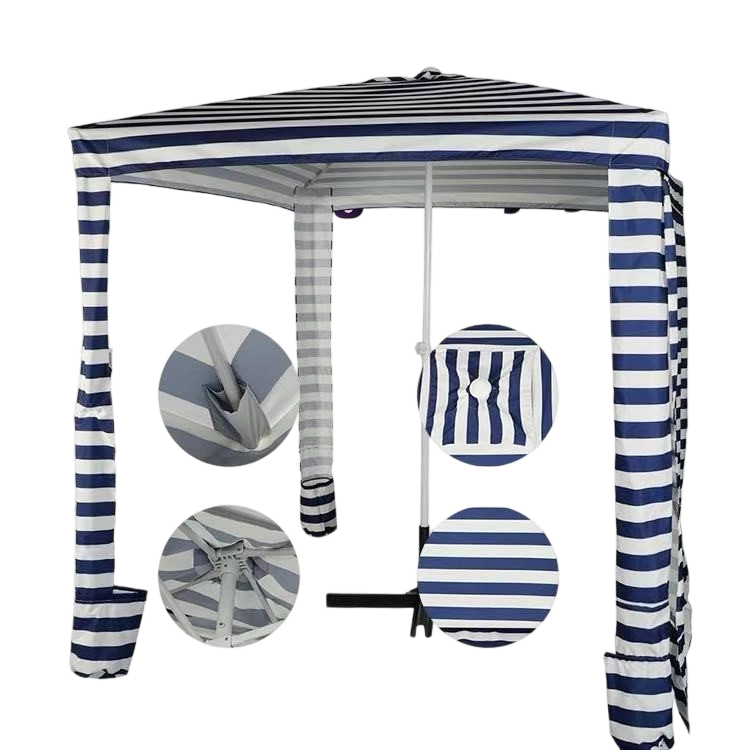 1.8m Square Steel-Frame Beach CabanaIts 1.8m square reinforced steel frame and 160G canopy suit semi-permanent resort or poolside placement, where larger canopies need planned anchoring and wind-load checks.View Product →
Gazebo-style canopies and cabanas follow similar rules with more surface area and more consequence. A large canopy on four legs needs either a frame that is pegged down or weights at every corner, and the wind load should be assessed before the canopy is opened, not after. On grass, pegs work; on paving, weights work; on sand, both work together.
For commercial users, the practical difference is duty cycle. A beach umbrella used by a family might be opened and closed twice a day for two weeks a year. A market stall umbrella may be opened at dawn and closed at dusk five days a week for a whole season, and the joints, fabric coating and hub will show that difference within months. Buyers in that situation should look at the mechanism rather than the print, because the print sells the first unit and the mechanism sells the repeat order.
Without sand to bury into, base weight and a secondary tie become the entire anchoring system, so choose the base before choosing the canopy.
What Retailers and Wholesalers Should Check Before Ordering
For a retailer, distributor or wholesale buyer, the question is not how to use one beach umbrella but how a few thousand of them will behave in the hands of customers who never read instructions. The specification list below is the one we work through with buyers, and it is a useful checklist for anyone sourcing beach umbrellas from a manufacturer or supplier.
- Pole diameter and wall thickness. Around 28 mm is common for light retail canopies; 32 mm and above is more typical for rental, resort and windy-coast programmes.
- Rib count and material. Eight ribs is the standard beach configuration, with fiberglass offering flex and spring-back that steel cannot match. The hub and rib pockets usually fail before the ribs themselves.
- Fabric weight and coating. Polyester in the 180 to 220 gsm range is a common middle ground for beach canopies, with a UV-blocking coating. Heavier fabric resists flapping better but adds weight to the carry bag.
- Ventilation. A vented canopy reduces lift and is worth specifying for windy markets even though it adds a small amount of sewing cost.
- Tilt mechanism. Check the joint under load. A plastic push-button tilt that feels tight in the sample may loosen after a season of daily use.
- Base and accessories. Decide whether the umbrella ships with a spike, a screw anchor, a sand bag or a cross base, and make sure the retail packaging states clearly what is included.
- Carry bag and printing. Shoulder straps, a zip that survives sand, and a fabric that takes a clean logo print matter more than most buyers expect.
- Consistency between samples and production. Ask for the fabric weight, rib specification and pole dimension in writing, and check production against the approved sample.
On the supply side, a manufacturer with an in-house production base has more control over these details than a trading-only supplier, especially when a retail programme needs a specific colour match, a printed carry bag or a mixed container of beach, garden and folding umbrellas. Factories used to handling both domestic wholesale and export orders generally have the sampling routine, the packaging options and the production planning to support repeat retail programmes rather than one-off purchases.
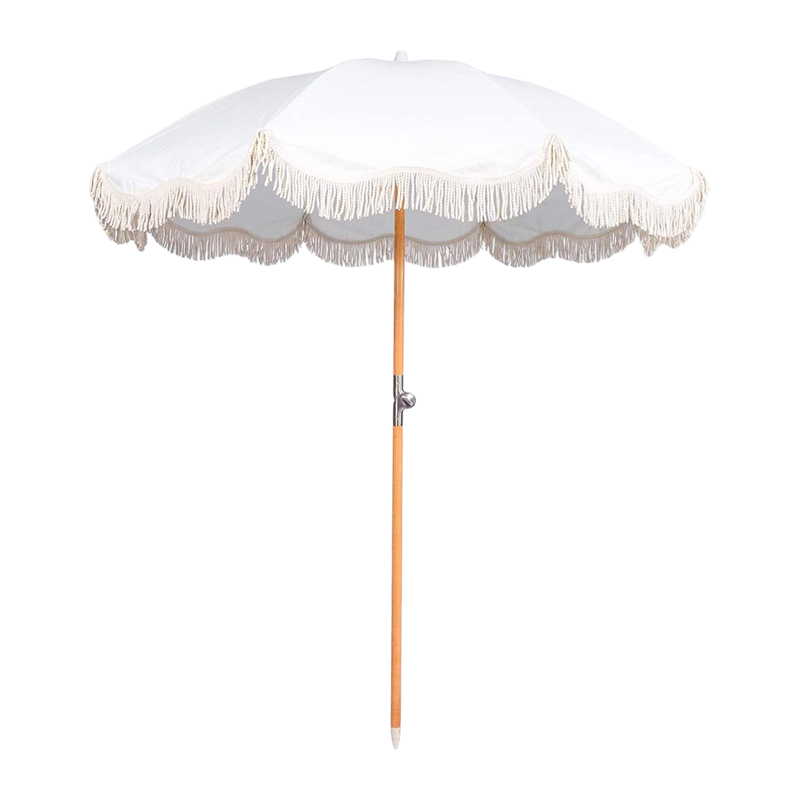
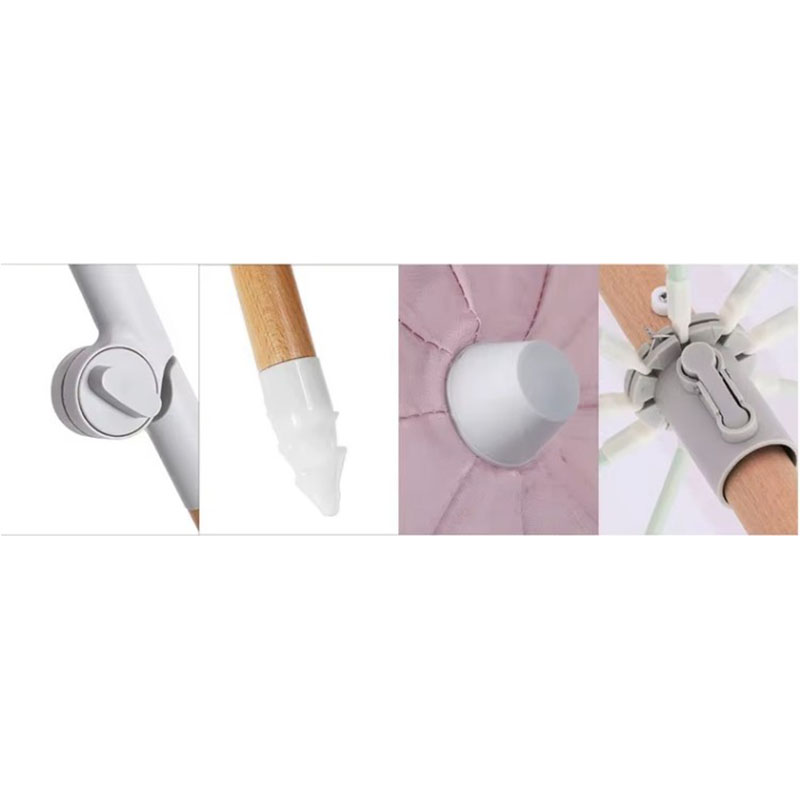 Cotton Beach Umbrella with TasselsIts 200G cotton canopy and tassel trim offer resort-style appeal, while 32mm wood pole and 5mm fiberglass ribs keep it functional for retail and hospitality.View Product →
Design details also sell. Tassels, straw-look finishes, matched colour sets and coordinated beach accessories are strong performers in resort shops and lifestyle retail because they photograph well and pair naturally with towels and bags. Those decorative elements should not come at the expense of the anchor, the rib pockets or the tilt joint, but a buyer who balances both usually gets a product that sells in season one and survives to season two.
Retail programmes succeed when the specification is written down: pole diameter, rib material, fabric weight, venting and included anchor decide the review score more than the print does.
Care, Storage and the Salt Problem
Salt is the quiet killer of beach umbrellas. It works its way into the hub, the tilt joint, the runner and the rib pockets, holds moisture against metal parts and accelerates corrosion that never happens on a garden umbrella. A thirty-second rinse at the end of the day makes a measurable difference over a season.
- Close the canopy and shake out loose sand before it works into the joints.
- Rinse the frame and fabric with fresh water, paying attention to the hub and the runner.
- Open the umbrella fully and let it dry completely in the shade before folding it.
- Wipe sand out of the tilt joint and the runner track with a dry cloth.
- Store loosely folded in a dry place rather than compressed in a hot car boot for weeks.
Small repairs are usually worth doing. A rib that has slipped out of its pocket can be re-seated in a few minutes. A hole in the fabric can be patched with a matching piece of canopy material and a fabric adhesive. A stiff runner often responds to a light clean rather than lubrication, because the usual cause is sand, not friction.
Off-season storage matters too. Umbrellas stored dirty, damp or folded under weight come out of winter with creased fabric, corroded springs and a canopy that never quite sits flat again. If you are storing retail stock in a warehouse, keep it away from damp floors and out of direct sun through windows, since long exposure will fade even UV-treated fabric.
Fresh water, a full dry and a loose fold at the end of the day add more seasons to a beach umbrella than any storage bag.
Safety, Etiquette and Leaving the Beach as You Found It
Most beach umbrella injuries are not dramatic. They are a canopy tip to the face, a pole left at eye height, or an umbrella rolling into someone on a windy afternoon. A few habits remove most of that risk.
- Close it when you leave. Not just for your own umbrella, but for everyone walking past.
- Keep poles out of walkways. Guy lines in particular are easy to trip over and should be marked or kept short.
- Watch children around the tilt joint and the runner. Fingers in a closing runner is the most common minor injury on family beaches.
- Do not dig into dunes. Dune vegetation stabilises the beach and is protected in many areas.
- Fill your hole before you go. A leftover 40 cm hole is a hazard for runners and a trap for small wildlife.
- Take the packaging with you. Bags, zip ties and tags blow away faster than anything else on the beach.
Etiquette is mostly about sightlines. If you are setting up in front of a group that has been there all morning, ask before planting a canopy that will block their view. If you are part of a large group with several umbrellas, line them up rather than scattering them, so the beach stays walkable for everyone else.
For rental operators and event organisers, the same points scale up. A clear layout plan, a closing policy for rising wind, and a quick end-of-day inspection of bases and guy lines will prevent most incidents before they happen, and it also extends the working life of the equipment.
Close the canopy, mark the lines and fill the hole before you leave, because the next person on that sand is not expecting your umbrella.
FAQ: How to Use a Beach Umbrella, Anchor It and Buy It Well
How deep should a beach umbrella pole go into the sand?
Around 30 to 45 cm is a practical starting range, and 45 cm is the figure often quoted in beach safety advice. Loose dry sand needs the deeper end of that range plus a secondary anchor, while damp compacted sand usually holds well at the lower end. Always rock and compact the pole rather than simply pushing it in.
Should a beach umbrella lean with the wind or against it?
Tilt the canopy into the wind, not away from it. Tilting into the wind lets gusts press the fabric down and reduces the lifting force at the base. A canopy tilting away from the wind catches air underneath and behaves like a sail, which is the setup most likely to pull the pole out of the sand.
Why does my beach umbrella keep falling over in soft sand?
Soft sand collapses around a pole, so depth alone does not solve the problem. The usual causes are a hole that is too wide, sand that has not been repacked, and a canopy left vertical and broadside to the wind. A screw anchor, a cross base or a couple of sand bags will usually fix it faster than digging deeper.
Is a vented beach umbrella better in wind?
In most coastal conditions, yes. A vented canopy allows air to pass through the top instead of collecting underneath, which reduces lift and flapping. It does not replace a good anchor, but it buys margin during the gusty part of the afternoon and reduces wear on the ribs and seams.
How many ribs should a beach umbrella have?
Eight ribs is the common standard for beach canopies and a reasonable balance between coverage, weight and stability. More ribs add stiffness and wind resistance but also weight and cost. For rental or windy-coast use, rib material matters as much as rib count, with fiberglass generally preferred for its flex and recovery.
Can one person set up a beach umbrella alone?
Usually yes, with the right order. Clear the sand, push and twist the pole to depth, rock it to compact, then open the canopy with the pole leaning slightly into the wind. Setting the tilt and opening the canopy before the pole is compacted is what makes solo setup difficult.
What is the difference between a beach umbrella and a patio umbrella?
A beach umbrella is designed to be carried, buried or anchored in sand, and tilted through a wider range. A patio umbrella is designed to sit in a weighted base or a table and is usually heavier, with a different pole and frame structure. Using a patio umbrella on sand is possible but needs a proper base, because the pole is not designed for burial.
How do buyers evaluate a beach umbrella manufacturer or supplier?
Start with the written specification: pole diameter and wall thickness, rib count and material, fabric weight and coating, hub construction, tilt mechanism and included anchor. Then compare the approved sample with production, check packaging and printing options, and confirm what the factory can repeat across a mixed container rather than in a single sample.
Good beach umbrella use comes down to three habits: bury and compact, tilt into the wind, and lower the canopy before the gust arrives.
Where to Go Next
Setting up a beach umbrella well is a small skill that pays back every sunny afternoon: read the wind, choose the sand, bury deep, compact, tilt and check. The equipment matters at the margins, but technique decides most of the outcome, and technique is free.
For buyers, the same logic applies in reverse. A beach umbrella programme that accounts for sand conditions, wind exposure and how customers actually use the product will outperform one that competes only on canopy print. That means specifying the pole, the ribs, the vent and the anchor together, and working with a manufacturer who can hold those details steady across repeat orders.
Explore the full beach umbrella range and the factory behind it:
Whether you are planting one umbrella or ordering a container, the same details decide the result: anchor depth, tilt angle, rib material and a canopy that lets the wind through.

Contact Us
-
Add:
On the east side of Baisong Road in Songyuan District, Shaoxing City, Zhejiang Province -
Phone:
+86-18457587893 -
Email:
grace@qyumbrella.com
Send Inquiry
To Contact Us
Copyright © Shaoxing Shangyu Qianyu Umbrella Co., Ltd. All Rights Reserved.
